St. Stephen’s Basilica
The church that rises above Budapest
Few buildings in Budapest play such a defining role in the cityscape, national memory, and religious life as St. Stephen’s Basilica.
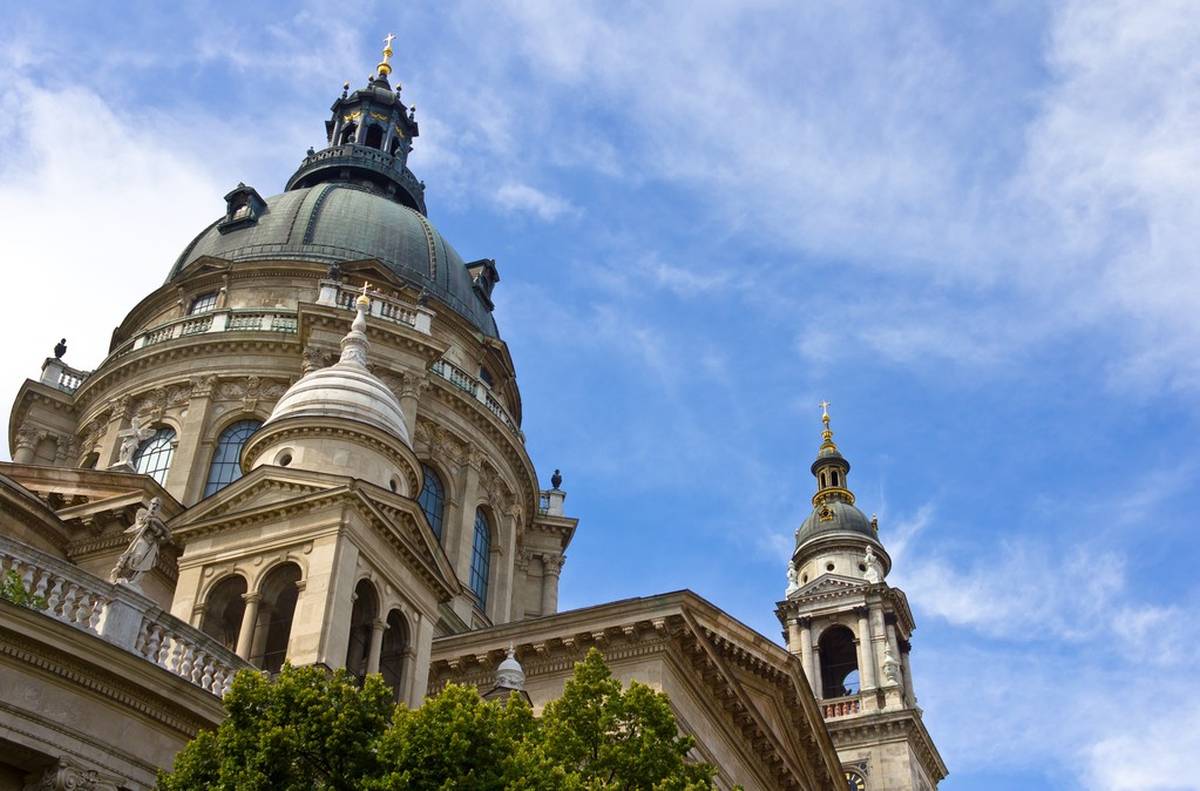
This monumental church, standing in the heart of Lipótváros, is not only one of Hungary’s most important religious buildings but also one of the capital’s most recognizable architectural symbols. Its 96-meter-high dome has defined Budapest’s skyline for decades, standing at the same height as the Parliament Building, creating a symbolic balance between state and ecclesiastical power.
However, the basilica is much more than just an icon of the cityscape. It is a building whose history encompasses faith, survival, national identity, and the evolution of Hungarian architecture over more than half a century.
St. Stephen’s Basilica is not the work of a single era, but a shared endeavor built over generations.
The church born from the memory of a flood
In the 18th century, the site of today’s basilica was home to the Heccszínház, a venue for animal fights. However, the rapidly developing Lipótváros district soon outgrew its temporary church, and the need for a representative parish church became increasingly urgent.
MORE
The breakthrough came with the great flood of Pest in 1838.
Many of the residents who fled to the slightly elevated area of today’s Szent István Square survived the disaster there and vowed to build a church at the site of their rescue.
Preparations for construction took years; finally, in 1845, József Hild was commissioned to draw up the plans. Construction began in 1851, but the monumental undertaking faced difficulties from the very start.
The church was built according to Hild’s Classicist designs until 1868, when the half-finished dome collapsed due to structural problems. Following this tragic structural failure, it took years to clear the rubble and reinforce the building.
The project was eventually taken over by Miklós Ybl, who completely reimagined the church and redesigned the original plans in the Neo-Renaissance style. The basilica’s current character was largely shaped by his vision.
The building’s final design and interior decoration were ultimately completed under the direction of József Kauser, and the church was consecrated in 1905.
The dome rising above Budapest
One of the most defining features of St. Stephen’s Basilica is its monumental dome. At 96 meters high, the building remains one of the tallest points in Budapest today, while offering one of the city’s most famous panoramic views. From the dome’s observation deck, nearly the entire capital is visible, stretching from the Danube to the Buda Hills.
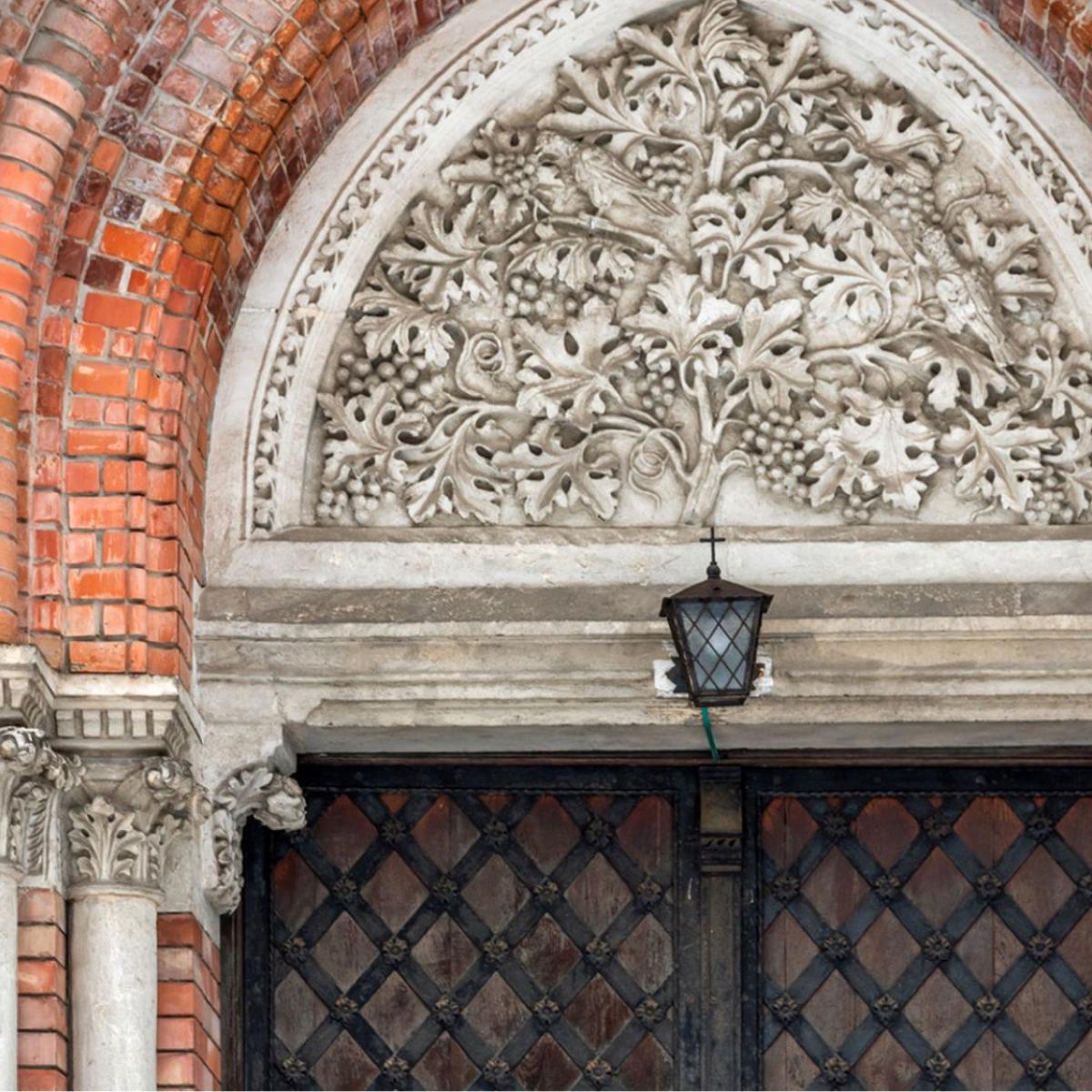
The building’s exterior combines Neo-Renaissance monumentality with a rich sculptural program and the classical proportions of church architecture. The main façade, spanning the two towers, is defined by Corinthian pilasters, a monumental tympanum, and a semicircular vestibule, which simultaneously conveys a sense of solemnity and openness toward the city. Above the façade is a Latin inscription, Ego sum via, veritas et vita (“I am the way, the truth, and the life”), one of Christ’s most famous biblical statements, which defines the symbolic message of the entire building.
The exterior sculptural decorations form a deliberate iconographic system. The tower niches feature the four great Doctors of the Church—Saint Ambrose, Saint Augustine, Saint Gregory the Great, and Saint Jerome—while the dome drum is adorned with statues of the four Evangelists. On the eastern side, the figures of the twelve apostles are arrayed beneath the figure of Christ, as if symbolically guarding the entire building.
The monumental interior
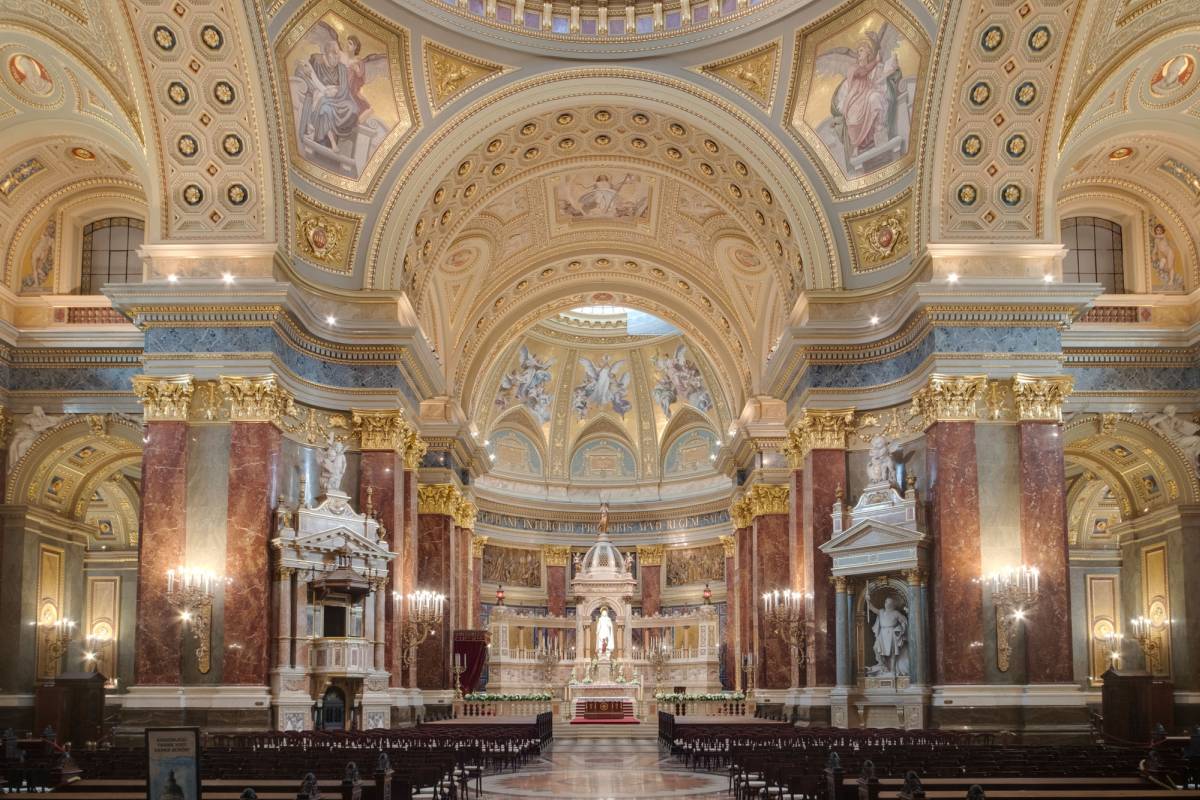
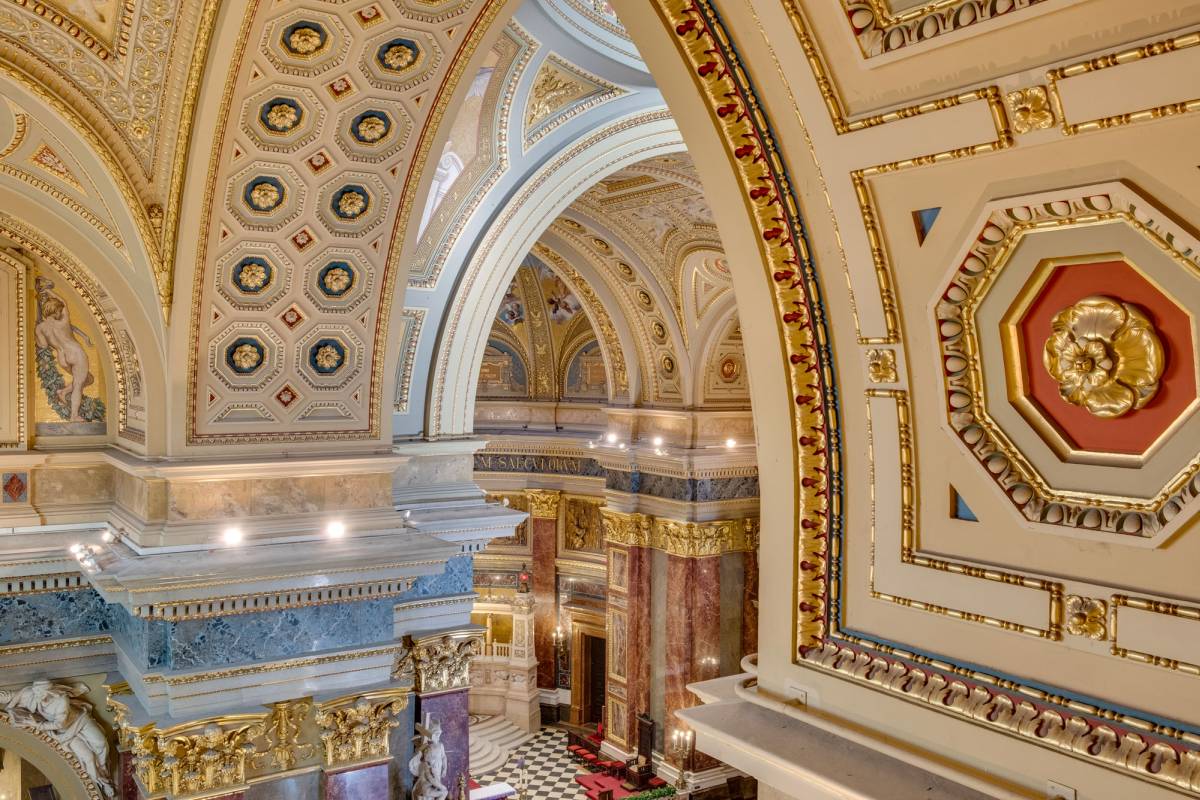
The interior of the basilica impresses not only with its monumental dimensions but also with its exceptionally rich program of fine and applied arts. This holistic artistic approach is evident even in the main entrance hall: visitors are greeted by Károly Senyei’s relief of St. Stephen, as well as the monumental mosaics by Bertalan Székely and Mór Than.
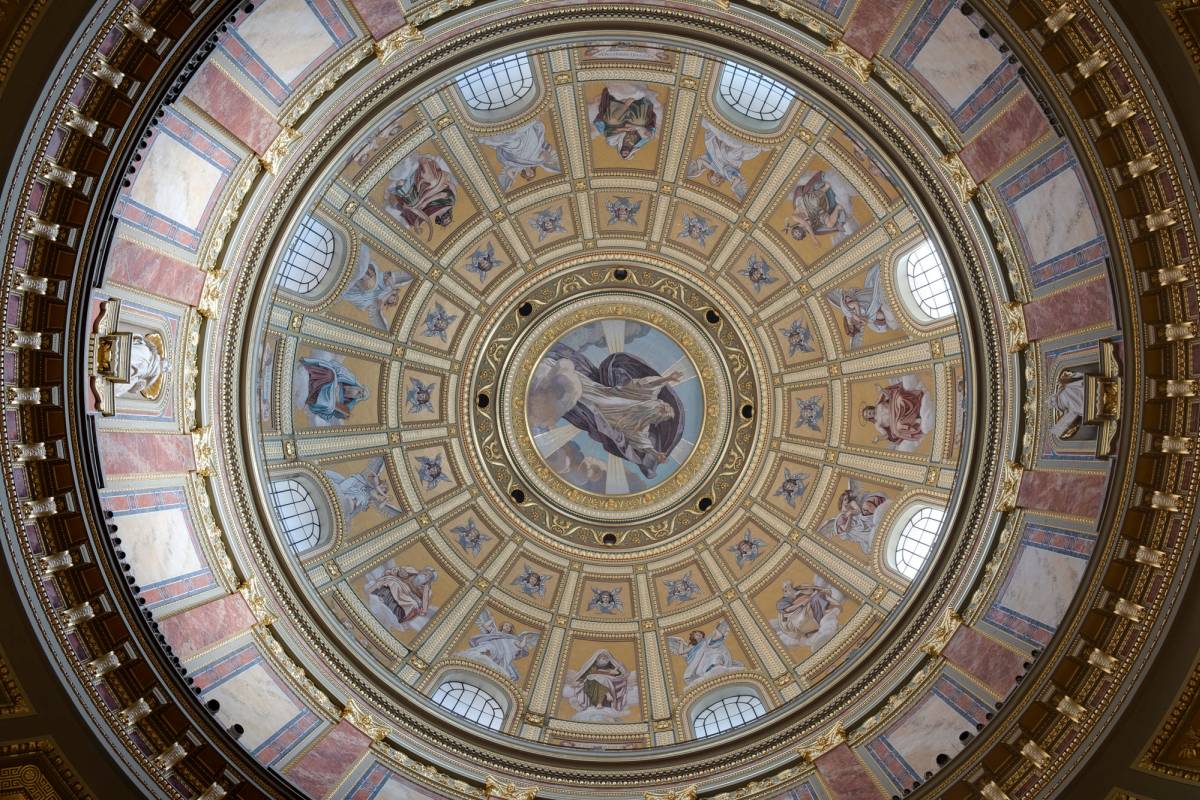
In the lower ring of the dome, God the Father appears in Károly Lotz’s frescoes, while the figures of Christ, the prophets, and the evangelists can be seen on the surface of the tambour. The iconography of the dome deliberately elevates the building to a symbolic center of the heavenly world and Christian teaching.
The mosaics on the sanctuary vault are the work of Gyula Benczúr, depicting allegories of the Holy Mass, while Ede Mayer’s series of bronze reliefs evokes important scenes from the life of Saint Stephen. The central element of the baldachin-covered high altar, designed by József Kauser, is Alajos Strobl’s monumental statue of Saint Stephen, which simultaneously embodies the founding king’s regal dignity and his sacred role.
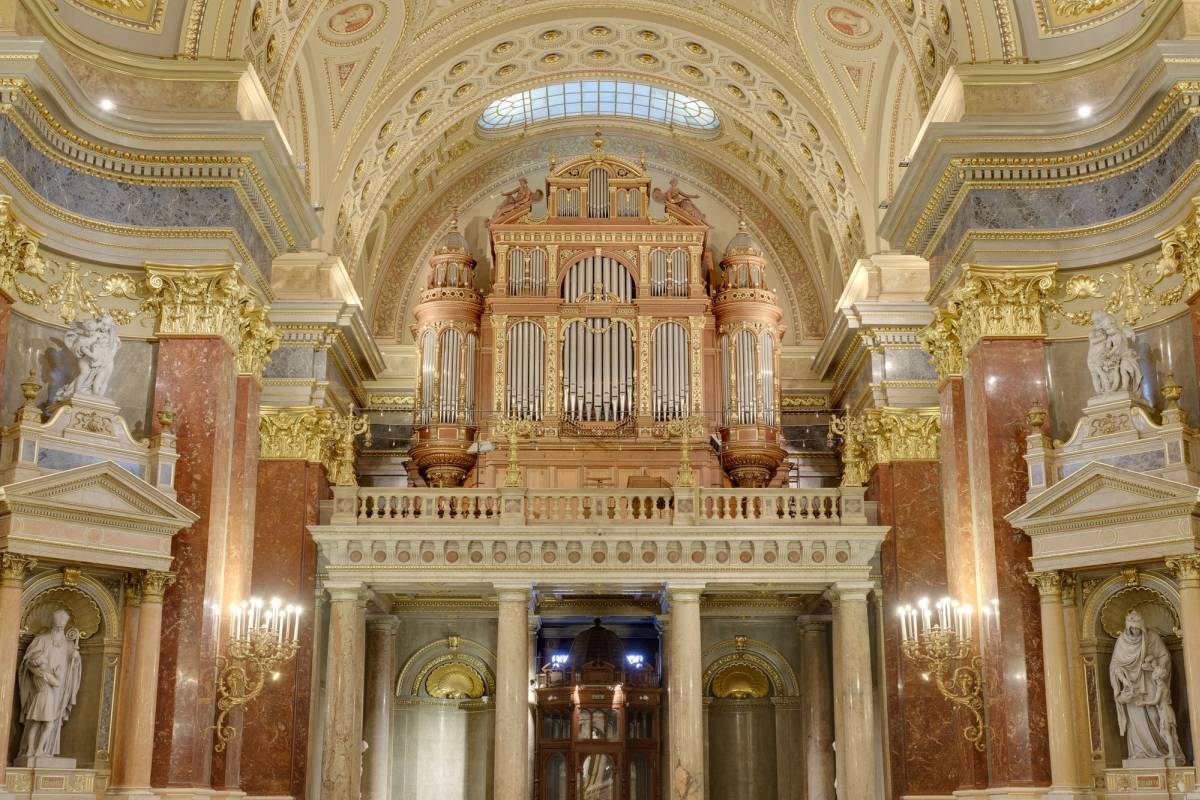
There is a special richness even in the details. The pulpit is also the work of József Kauser, while the stained glass and glass painting works were created by Miksa Róth. The basilica’s organ came from the workshop of József Angster in Pécs, one of the most renowned instrument makers of the era, while the execution of the interior’s gilded and painted ornamentation was led by Róbert Scholtz. The interior thus becomes simultaneously a liturgical space, a national memorial, and one of the most complex works of Hungarian historicism.
The place where the Holy Right is kept
The basilica is not only an architectural and religious center, but also one of the most important symbolic sites of Hungarian statehood.
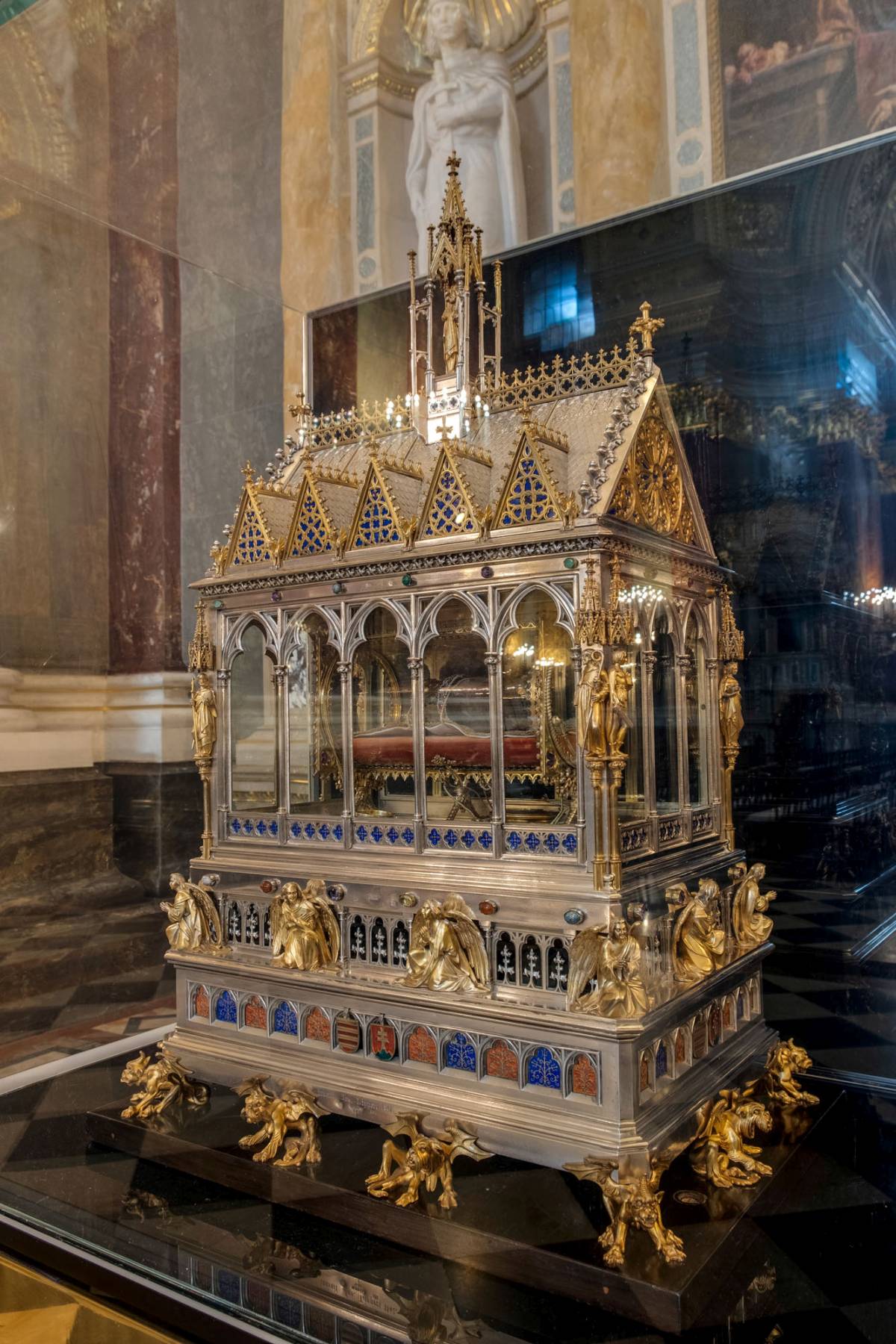
It is here that the Holy Right—the preserved right hand of Saint Stephen—is kept, which is one of the most important relics of the founding of the Hungarian Christian state. The Holy Right has been in its permanent resting place, the basilica’s chapel, since 1971. The Holy Right procession on August 20 has since become one of the best-known events in Hungarian Catholic tradition.
The history of the 20th century also played an important role in the basilica’s history. The building was severely damaged during the Siege of Budapest and later required complete renovation on several occasions. During the reconstruction that began in the 1980s, not only was the structure reinforced, but the mosaics, frescoes, sculptures, and stained-glass windows were also restored. The renovation was completed in 2003, when the basilica received its now-famous decorative lighting and a revitalized surroundings.
Source of images: Saint Stephen's Basilica website.
Facts




Constructed Stories was created by