New York Palace
The palace where Budapest’s literary life found a home
One of the most imposing buildings on Erzsébet Boulevard has stood amid the bustle of the Grand Boulevard for over a century, yet it is difficult to view it merely as a building. It is at once a palace, a hotel, an office building, and a symbol of cultural history.
The historicist-style palace was built in 1894 as the Hungarian headquarters of the New York Life Insurance Company, complete with rental apartments, a café, and retail spaces. However, the New York Café, which opened on the ground floor, soon took on a life of its own and quickly became one of the most important meeting places of Budapest’s artistic and literary life.
Thus, the New York Palace became not simply one of Budapest’s most beautiful buildings, but a place where stories, manuscripts, legends, and eras were born.
The Palace that came to Budapest from America
The story began in the late 19th century, when the New York Life Insurance Company decided to build its Budapest headquarters.
More
The design competition for the prestigious palace was won by a team led by Alajos Hauszmann, with contributions from Flóris Korb and Kálmán Giergl. The era’s most prominent craftsmen and artists worked on the building: in addition to the Ganz and Zsolnay factories, a whole host of sculptors, painters, and glass-painting workshops participated in the construction.
Opened in 1894, the palace became one of Budapest’s most outstanding examples of historicism. The façade, which blends Neo-Baroque and Renaissance elements, is crowned by rich ornamentation, allegorical sculptures, and a tower nearly 60 meters high.
The Palace’s facade
The palace’s richly articulated facade is one of the most striking examples of historicist architecture in Budapest. The rustic limestone cladding and generous window arrangement of the lower levels provide a solid, monumental foundation for the building, from which the massive columns, ornate cornices, and finely crafted stone carvings of the lighter-toned upper levels gradually rise.
The details of the façade conceal a new motif in nearly every square meter: balustrades, obelisks, tympanums, allegorical figures, and richly ornamented pilasters transform the building into a veritable theatrical set. The sculptural program was also deliberately linked to the identity of the former insurance company: the Atlas figures at the main entrance evoke the different stages of human life, while the female figures on the upper levels symbolize wealth and thrift.
The corner towers and the main façade feature allegorical figures of America and Hungary, as well as figures of the genius of liberty, while the spire is crowned by the former insurance company’s emblem, an eagle with outstretched wings.
Marble, bronze, and an urban legend
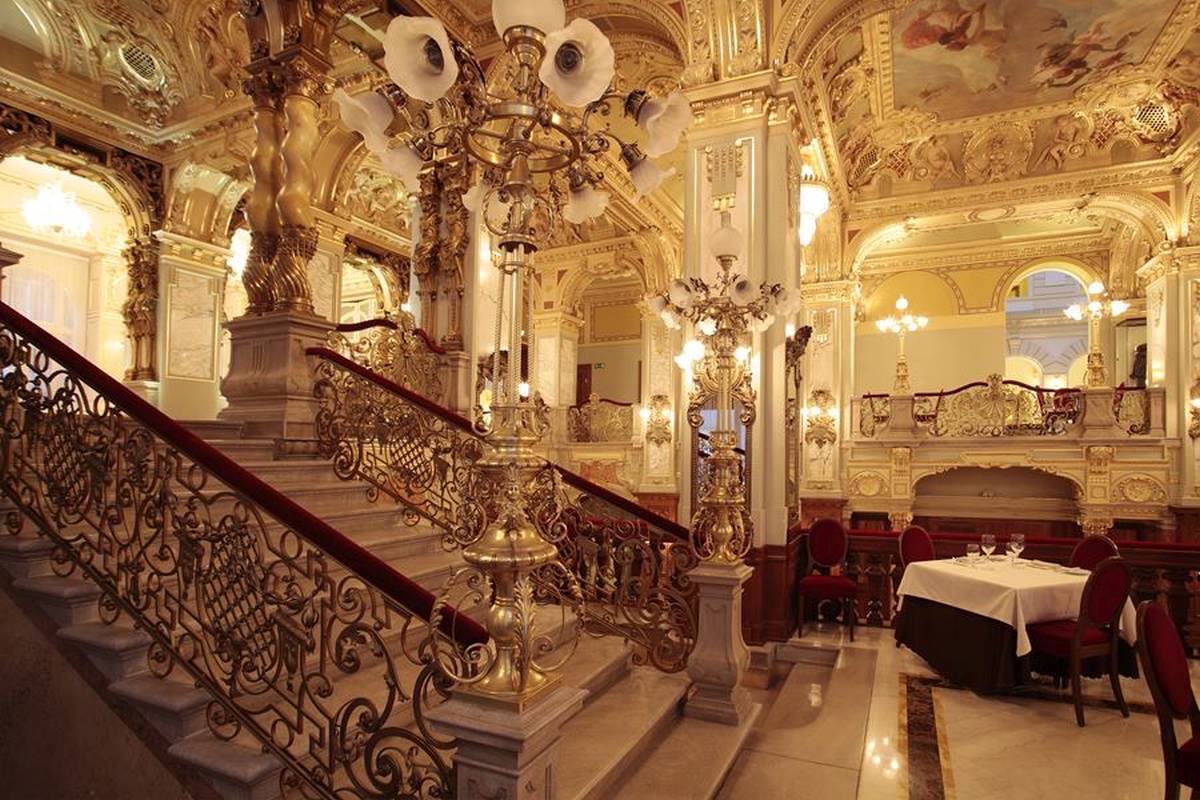
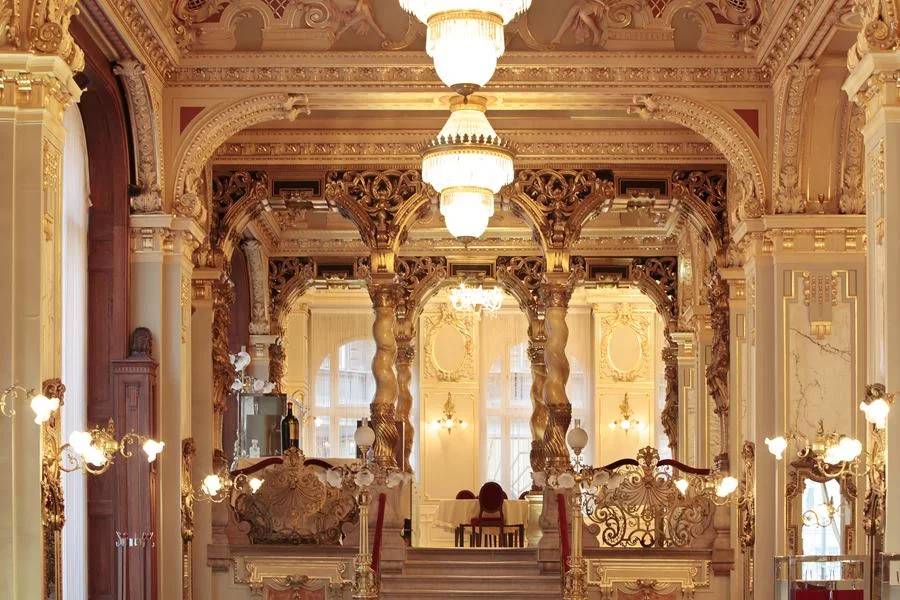
The interior of the New York Palace is at least as monumental as its façade. The three-nave, multi-level interior is defined by marble cladding, fluted columns, gilded ornamentation, bronze lamps, frescoes, and arcades. The ceiling paintings feature mythological figures, bacchantes, and allegorical figures, while the space as a whole is simultaneously enveloped by the monumental grandeur of a palace and the bustling atmosphere of a coffeehouse.
According to legend, at the opening, the keys to the café were thrown into the Danube so that the place would never close. Although the veracity of the story is disputed, it clearly illustrates how quickly the New York Café became a legend of Budapest’s cultural life.
The place where literary history was made
In the early decades of the 20th century, the New York Café became one of Budapest’s most important literary hubs. Journalists, editors, poets, and writers worked and debated at its tables. Among the era’s most famous writers, Ady Endre, Ferenc Molnár, Dezső Kosztolányi, Frigyes Karinthy, Gyula Krúdy, and Zsigmond Móricz were regulars here.
The café was not only a meeting place but also functioned as an informal editorial office. Waiters brought the writers long, narrow pieces of paper—known as “dog tongues”—on which they often wrote their articles, short stories, or poems.
The New York Café was a hub for literature, journalism, the visual arts, music, and theater all at once. It served as one of the most important intellectual centers of turn-of-the-century Budapest.
The Palace that was reborn time and again
World War II and the decades that followed marked a major turning point in the history of the New York Palace. The building was damaged, the café was looted, and after nationalization, it lost its original function for a long time. The New York Café continued to operate under the name Hungária, while the building served as an office complex, a “press palace,” housing editorial offices and publishing companies.
For a long time after the fall of communism, the building’s future remained uncertain. Ideas for repurposing it as a theater, an office building, or a mixed-use facility were considered, but in the early 2000s, a decision was finally made to completely renovate it and convert it into a luxury hotel.
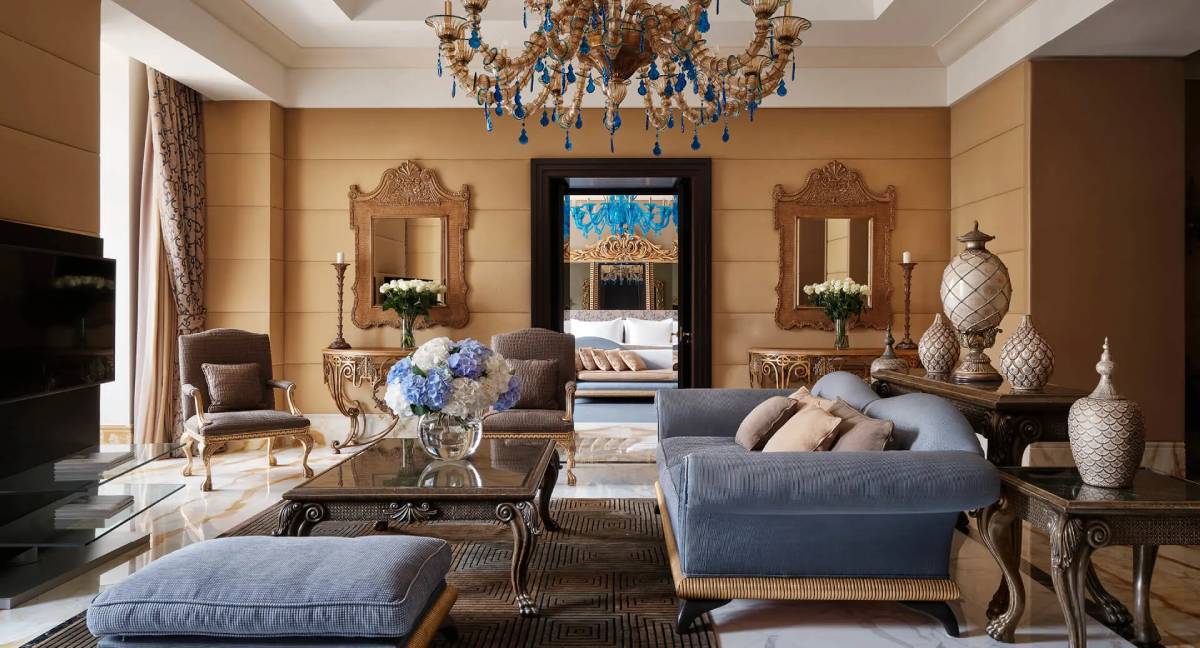
The goal of the renovation was to restore the building to its original splendor. The restoration ultimately took several years, and it reopened in 2006 as the Boscolo New York Palace Hotel. The renovation was recognized with the Europa Nostra Award in 2007. Since 2020, the building has continued to operate under the name Anantara New York Palace Budapest Hotel.
One of Budapest’s most famous cultural landmarks
Today, the New York Palace is a historic landmark, a luxury hotel, and a tourist icon all in one. In recent years, the New York Café has once again become one of Budapest’s most famous meeting places. Thanks to its all-day live music programs, historic interior, and cultural heritage, it is now a top destination not only for Budapest residents but also for tourists from all over the world.
Thus, the building continues to fulfill the same role today as it did over a century ago: it simultaneously represents Budapest’s elegance, cultural richness, and that unique urban atmosphere in which architecture and history are inextricably intertwined.
Source of images: Anantara New York Palace Budapest Hotel website, New York Café website
Facts





Constructed Stories was created by